The CCTV retention period for private schools must be at least 90 days in the areas specified in the letter dated 23.07.2026 from the MEB General Directorate of Private Education Institutions. This reflects the implementation adopted by an Official Approval following the annulment decision of the 8th Chamber of the Council of State, and differs from the earlier 15-day wording published in the regulation.
Camera placement and the protection of recordings are just as important as the retention period. The following sections bring together the institutions and areas specified in the letter, how to calculate disk capacity, and points to consider under the KVKK.
Which areas are covered by the 90-day requirement in the MEB letter?
Article 11, paragraph 4 of the MEB Regulation on Private Educational Institutions stipulated a minimum recording period of 15 days in the published text. In its letter dated 23.07.2026, reference number E-16915068-010.99-164901079, the General Directorate set out how the paragraph should be implemented following the annulment decision of the 8th Chamber of the Council of State and an Official Approval. Accordingly, the CCTV system must store footage for at least 90 days in the following areas:
- In institutions required to have a garden area: all entrances to and exits from the garden, all building doors and corridors.
- In other institutions: all building doors and corridors.
Therefore, when planning the recording period for a private school’s CCTV system, it is important to consider not only how many days recordings are retained, but also whether the specified areas are covered by cameras. This requirement does not mean that a camera must be installed in every room.
Where can cameras be installed, and which areas are excluded?
The recording areas specified in the letter are entrances and exits, and corridors. At institutions where a garden is required, all entrances and exits to the garden must also be covered. When preparing the camera layout, the field of view should be assessed to ensure that cameras can see doors and routes used for passage.
Cameras must not be positioned to view the inside of classrooms, staff rooms, managers’ rooms, work or rest rooms, guidance rooms, libraries, sports halls, swimming pools, toilets and washrooms, places of worship or similar facilities. Installing cameras in private areas such as toilets and changing rooms is also inappropriate.
The exception is special education schools and special education and rehabilitation centres. In these institutions, cameras may be positioned to view the inside of classrooms and areas where lessons are held; these recordings must also be retained for at least 90 days. This exception applies only to the specified institutions and areas.
How to calculate disk capacity for 90 days of recording
The capacity calculation uses the number of cameras, each camera’s average bit rate, recording hours and number of days. For continuous recording, the F_CCTV calculation can be written as follows:
F_CCTV (TB) = number of cameras × bit rate (Mbps) × 86.400 × recording days ÷ 8 ÷ 1.000.000
The result of this formula is the approximate storage requirement in decimal terabytes. For example, assume that 16 4 MP cameras record at an average bit rate of 4 Mbps per camera using H.265, for 24 hours a day over 90 days. Resolution of 4 MP alone does not determine the bit rate; 4 Mbps is the assumption used in this example.
One camera generates approximately 43 GB of data per day: 4 Mbit/s × 86.400 seconds ÷ 8 ≈ 43.200 MB. Accordingly, 16 cameras require approximately 691 GB per day, or approximately 62,2 TB of raw capacity for 90 days. The actual disk plan should allow for this figure to be increased to account for disk formatting, the recorder’s usable capacity and any RAID configuration.
H.265 and H.265+ compression can significantly reduce disk requirements compared with H.264; however, the same level of saving should not be assumed for every installation. Motion-triggered recording can also reduce data volumes, but its compatibility with any continuous-recording requirement or the institution’s recording approach should be assessed separately. For a detailed calculation, see CCTV recording duration and HDD calculation.
Recording system continuity and disk health
Meeting the 90-day target requires more than simply having sufficient disk capacity. A suitable UPS can be planned to keep the recorder running during a power cut and, in IP systems, to power the PoE switches supplying the cameras. The UPS capacity should be selected based on the connected equipment’s load and the required runtime.
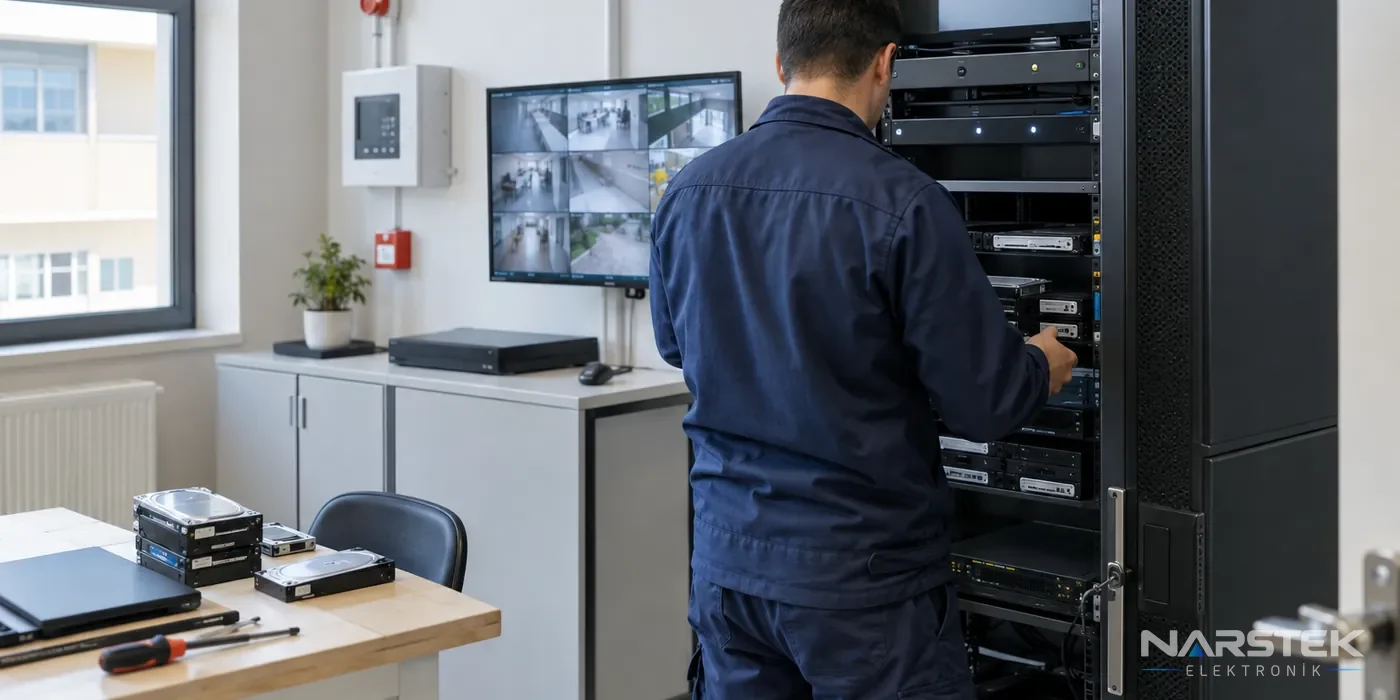
In systems with multiple disks, RAID can help maintain recording continuity in the event of a disk failure; usable capacity depends on the RAID configuration. RAID is not a separate backup copy, and the space reserved for protection must be included in the capacity calculation. Disk health and error warnings on the recorder should be monitored regularly, and surveillance-grade disks suitable for 7/24 use should be selected.
IP cameras can be powered over a single cable using IEEE 802.3af/at PoE and connected to an NVR. Analogue HD cameras such as HDCVI, TVI and AHD operate over coaxial cable and are recorded by a DVR/XVR. When selecting a new recorder, its channel count, disk bays and total capacity must meet the camera count and recording target. You can explore the different options on the Recorders (NVR / DVR) page.
KVKK and common CCTV planning mistakes in schools
Recording images with cameras constitutes the processing of personal data. Schools must visibly inform people that CCTV monitoring is in operation, limit recordings to a defined purpose and restrict access to authorised personnel. When determining the retention period, the minimum requirement of 90 days in the Ministry of National Education’s letter must be taken into account, and recordings must be managed in accordance with the Turkish Personal Data Protection Law (KVKK).
According to the Ministry of National Education’s letter, recordings are reviewed only if requested by the competent authorities as part of a judicial or administrative investigation. Defining access permissions and restricting who can view recordings should form part of the school’s data processing arrangements.
The main planning gaps we encounter in practice include installing cameras only at the main entrance while overlooking other doors and corridors, calculating disk capacity based on resolution rather than the actual bit rate, and failing to monitor disk failure warnings. Positioning cameras so that they view prohibited areas can also create privacy and KVKK issues. To review the scope of our installation or existing system capacity checks, see our CCTV installation and maintenance service.
Example recorders from our catalogue
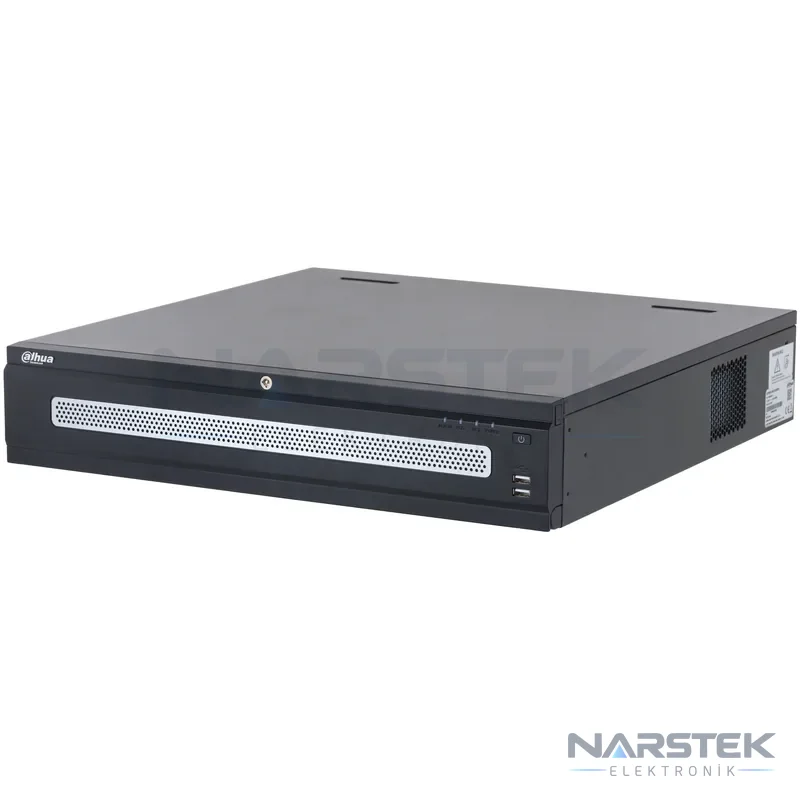
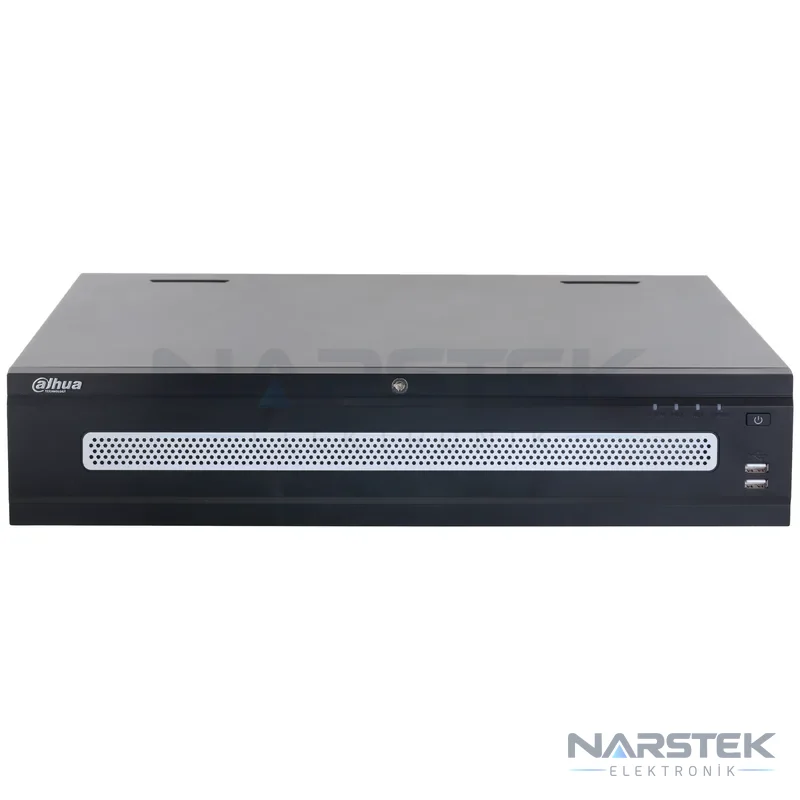
- The Dahua NVR5816H-XI supports recording from 16 IP camera channels and up to eight HDDs.
- The Dahua NVR5816RH-XI is listed with 16 channels, eight disk bays and RAID options.
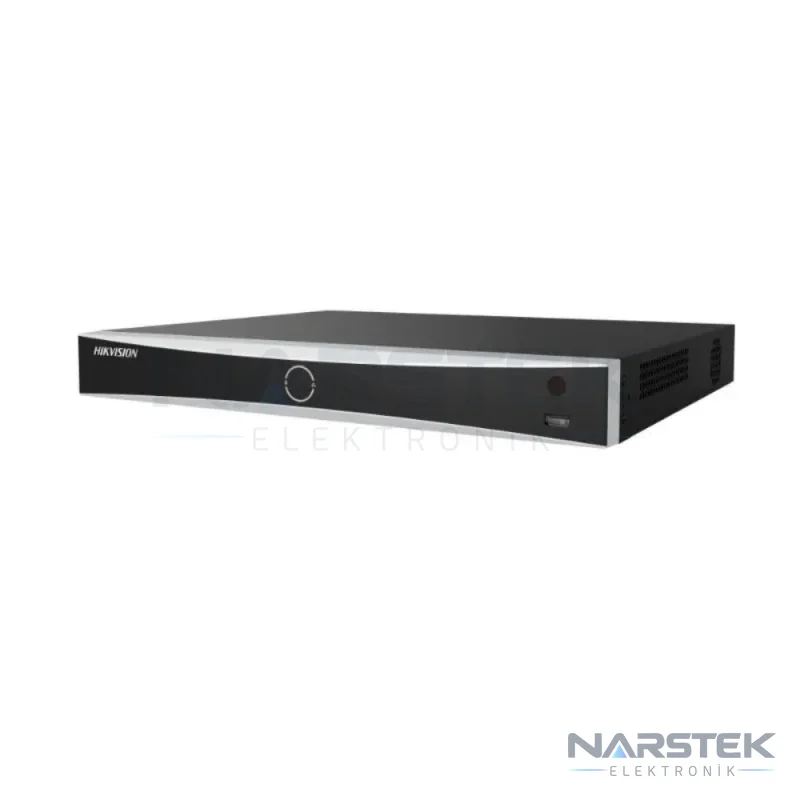
- The Hikvision DS-7608NXI-I2/VPRO supports up to eight IP camera channels and two HDD bays.
These devices are examples. When selecting a model, check the total number of cameras, recording bit rates, usable capacity for 90 days and the existing infrastructure together.
Request a site survey and capacity quote from Narstek
Narstek Elektronik provides site surveys, installation, maintenance and capacity upgrades for CCTV systems in Istanbul. For an initial assessment, share the number and resolutions of the cameras, the recorder model, the number and capacities of the existing disks, the recording settings and the target recording period. A floor plan or a list of the areas covered by the cameras will also help us review the layout.
You can submit your site survey or quote request via the form, call 0212 424 07 24, or message us on WhatsApp at 0540 001 07 24. If there is a recording interruption or disk warning on your existing system, please mention this in your quote request too.
Frequently asked questions
How long must CCTV footage be retained in private schools?
Footage from the areas specified in the letter dated 23.07.2026 from the MEB General Directorate must be stored for at least 90 days. For institutions required to have a garden area, garden entrances and exits are also included.
Can cameras be installed in school classrooms?
As a general rule, cameras must not be positioned to view the inside of classrooms. As an exception, the interiors of classrooms and teaching areas in special education schools and special education and rehabilitation centres may be monitored by camera; recordings must be retained for at least 90 days.
How much storage space is needed for 16 4 MP cameras recording for 90 days?
Assuming an average of 4 Mbps per camera and continuous recording, approximately 62,2 TB of raw capacity is calculated. Since 4 MP resolution alone does not determine the bitrate, the actual requirement depends on recording settings and usable disk capacity.
Who can view school CCTV recordings?
According to the MEB letter, recordings may be viewed only when requested by authorised authorities as part of a judicial or administrative investigation. Under the KVKK, access permissions must be restricted and the use of camera surveillance must be clearly signposted.
Share the panel brand, number of devices and address, and we’ll get back to you about a site survey and quote.