
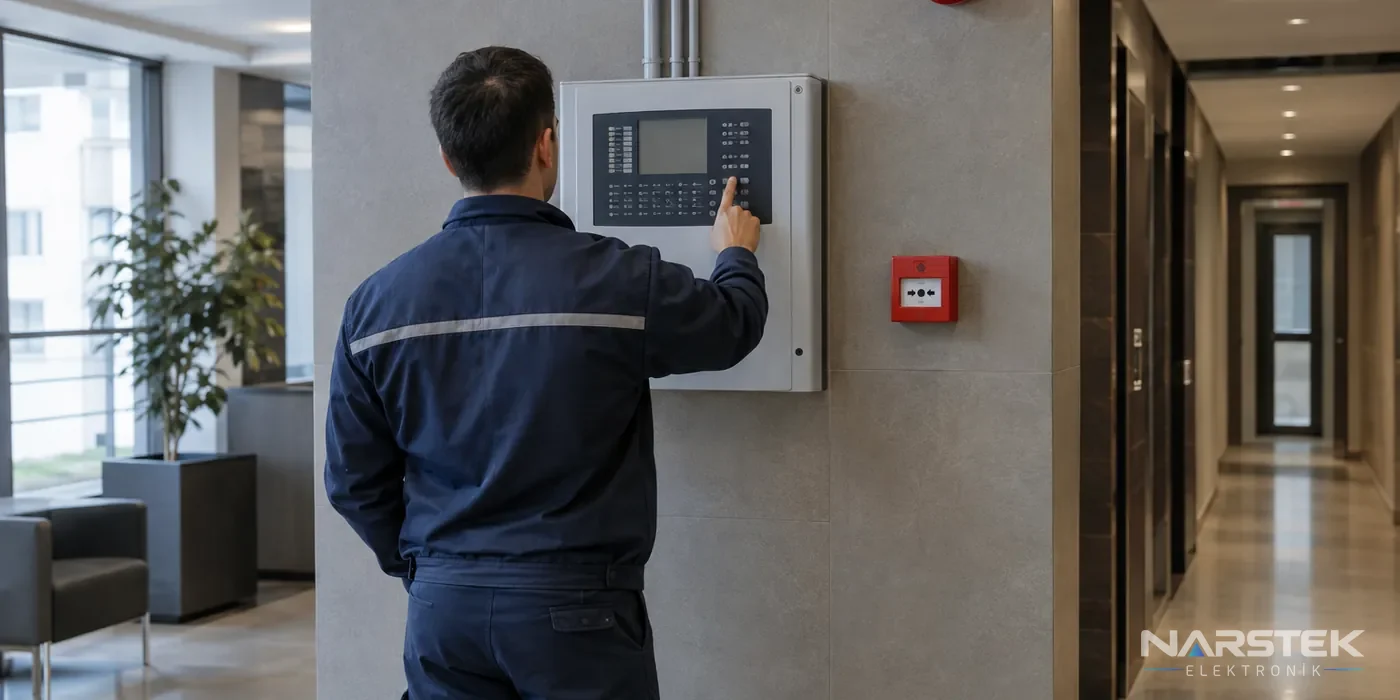
A fire alarm inspection for a fire brigade report does not just check whether a system is present in the building. The alarm’s operation, the appropriate positioning of manual call points and sounders, the panel’s condition, the backup battery and maintenance records should also be checked.
Reviewing these points against the building plans before the inspection can help you identify any shortcomings early. The checklist below is a guide to preliminary preparation; the final assessment depends on the building’s conditions and the competent authority’s inspection.
Check the regulatory deadlines before the inspection
Amendments to the Regulation on the Protection of Buildings from Fire, made by Presidential Decision No. 10026, were published in the Official Gazette dated 1 July 2025, issue No. 32943. Provisional Article 4, added to the Regulation, provided until 31 December 2025 for shortcomings in existing buildings that required time to procure materials to be addressed. That deadline has passed, and as of November 2026 no further extension has been incorporated into the text of the Regulation. Inspections to establish whether the shortcomings have been remedied are therefore now under way. You can also read our article on Decision No. 10026 and Provisional Article 4 for details on the scope and implementation of the amendment.
There is also a separate provision to note for accommodation facilities. Provisional Article 9 of the amendment to the Regulation on Business Opening and Operating Licences, published in the Official Gazette dated 10 January 2026, issue No. 33133, provides for inspections of accommodation premises that were granted a period under Provisional Article 4. If they cannot produce a fire brigade report demonstrating compliance with the Regulation on the Protection of Buildings from Fire, these premises will be prohibited from operating until 31 May 2026; premises still unable to submit a report by the end of the period will have their licences revoked and be closed. When assessing your facility’s situation, also see our article on fire alarms in hotels and accommodation facilities.
Is the fire alarm system operational?
First, verify that the entire system is operational. Check for faults, disabled zones or persistent warnings on the panel. A normal status on the display alone is not enough; test that detectors, manual call points and alarm devices transmit signals to the panel and that the panel initiates the alarm sequence.
During testing, inform the people responsible for the premises. If there is a risk that the alarm could inadvertently trigger an evacuation or external systems, these steps should be managed by authorised technical personnel. Once testing is complete, return the system to normal operating mode and confirm that any disabled points or zones have been re-enabled. For more comprehensive maintenance steps, use the fire alarm system maintenance checklist.
- Note any faults and warnings shown on the panel and arrange for them to be resolved before testing.
- Test the devices specified in the project and maintenance plan, rather than only representative devices from each zone.
- Confirm that the alarm reaches the panel and that audible or visual warnings are activated.
- After testing, check that the panel and system components have returned to normal operating mode.
How should the panel, manual call points and sounders be inspected?
The fire alarm control panel should be in a location where the people responsible for the building can reach and see it. Access must not be obstructed by materials, furniture or a locked door, and the information on the display and the indicator lights must be legible. If the panel display shows a fault message, is unclear, or has an indicator that is not working, arrange for a service inspection before the authority’s inspection.
Check the manual call points on each floor, along escape routes and at the locations shown in the project. They must be unobstructed, clearly marked and accessible. If a call point needs to be relocated, do not base the decision on convenience alone; compare the proposed position with the project and the relevant technical assessment. For guidance on call point placement, see the article on the positioning of fire alarm call points and sounders.
Check that sounders and other audible warning devices operate in different areas of the building. You cannot determine whether the alarm can be heard everywhere by listening only beside the panel. Test different areas, including enclosed rooms, corridors and noisy work areas, and report any locations where the alarm is inaudible or weak to the technical team. The number and location of devices should be assessed against the project.
Batteries, maintenance records and project documentation
During maintenance, check the backup batteries expected to power the system during a mains failure. Look for loose or damaged battery connections and any battery fault warning on the panel. A battery’s condition cannot be determined from its appearance alone; technical personnel should decide whether it needs testing or replacement in accordance with the requirements of the panel, battery and manufacturer’s documentation.
Article 84 of the Regulation on the Protection of Buildings from Fire requires emergency lighting, directional signage, and fire detection and alarm systems to undergo periodic inspection, testing and maintenance under the responsibility of the building owner and manager, or a building representative to whom these responsibilities have been formally delegated in writing. The Regulation does not set maintenance intervals in days or months; the frequency is determined in accordance with the relevant standards and system requirements. Therefore, keep dated maintenance records of the tests carried out, faults found, parts replaced and outstanding work.
Compare the existing fire alarm project with the device locations on site. Alterations, the addition of partition walls, a change in how an area is used or a panel replacement may have created differences between the project and the current installation. Having the project and maintenance records available for the inspection will help the technical assessment proceed more smoothly. For maintenance and servicing, see our Security Systems Servicing and Maintenance service.
Pre-inspection checklist
| Check item | What to check | If anything is missing |
|---|---|---|
| Fire panel | Accessible, clearly visible and with a readable display | Log a fault and call technical support |
| System operation | Alarm signals reach the panel and alerts are activated | Plan testing and fault rectification |
| Call Points | At the location shown in the project, unobstructed and accessible | Assess the location against the project |
| Sounders | Audible and operational in different areas of use | Ask the technical team to check audible warning coverage |
| Batteries and records | No battery warning; maintenance and test records available | Arrange a battery test and maintenance check |
| Project | Consistent with the devices and areas on site | Identify the differences and assess the project status |
This table does not cover every aspect of a building’s fire safety inspection. An assessment for a fire brigade report may also consider fire safety conditions elsewhere in the building, in addition to the fire alarm system. Recording alarm-related issues individually helps you distinguish work requiring maintenance from work requiring changes to the project or installation.
Request a preliminary inspection and quote from Narstek
Narstek Elektronik Bina Teknoloji San. ve Tic. Ltd. Şti., based in Istanbul, provides site surveys, design, installation, maintenance and fault repair services for fire detection and alarm systems. During a pre-inspection, the condition of the panel, devices on site, operation of the warnings, batteries and records can be assessed together. A pre-inspection does not replace a report or compliance decision by the competent authority; it is a technical assessment intended to identify issues in advance.
When requesting a quote, provide the business’s full address, type of use, number of floors and approximate area, the make and model of the fire alarm control panel, and any existing project documentation or latest maintenance record. If the inspection date is known, include it, along with photos of any fault messages shown on the panel and any access restrictions. This will help us plan the scope of the site survey and the necessary technical preparations more accurately.
You can complete the site survey / quote form, call 0212 424 07 24 or message 0540 001 07 24 on WhatsApp.
Frequently asked questions
What is checked during a fire alarm inspection for a fire brigade report?
The system’s operation, whether the panel is accessible and free of faults, whether manual call points and sounders match the project, whether audible warnings can be heard in different areas, and the batteries and maintenance records may be checked. The scope of the inspection depends on the building and the assessment of the competent authority.
How often is fire alarm system maintenance legally required?
Article 84 of the Regulation does not specify a particular number of days or months. The frequency of periodic inspections, testing and maintenance is determined by the system requirements and relevant standards.
Is it sufficient for the sounders to operate only next to the panel?
No. You need to check whether audible warnings can be heard in different areas of the building. Enclosed rooms, corridors and noisy work areas should also be included in the test plan.
How does the fire brigade report process affect accommodation facilities?
Accommodation premises that have been granted a period under Provisional Article 4 are subject to inspection under Provisional Article 9. The provision states that workplaces unable to produce a fire brigade report will be prohibited from operating until 31 May 2026, and that premises still unable to submit a report by the end of the period will have their licences revoked and be closed.
Share the panel brand, number of devices and address, and we’ll get back to you about a site survey and quote.