The fire alarm maintenance checklist shows which components should be inspected in sequence during a visit and how test results should be recorded. Maintenance begins with a review of event logs and proceeds through checks of the panel and power supply, device testing, circuit checks and reporting.
The building manager or person responsible for the premises can carry out some brief visual checks regularly. Testing detectors, adjusting panel settings and activating control outputs should be performed using methods appropriate to the system and by suitably qualified personnel.
How the scope and frequency of maintenance are determined
Under Article 84 of the Regulation on the Protection of Buildings from Fire, fire detection and alarm systems must undergo periodic inspections, testing and maintenance at the intervals required by the relevant standards for the system. This is the responsibility of the building owner and manager, or of a person to whom responsibility has been delegated in writing. The article does not set a fixed frequency in days or months. Frequency is determined by taking the system’s characteristics and relevant standards into account.
At least two comprehensive maintenance visits a year, with brief user checks between visits, is common practice in the sector. This should not be treated as a fixed number that is mandatory for everyone under the regulation. Fire detection and alarm systems in workplaces are also subject to periodic inspection under the Regulation on Health and Safety Conditions in the Use of Work Equipment. Under the specified regulations, this inspection is carried out once a year, based on the installation project and TS CEN/TS 54-14.
The amendment dated 23 December 2025 states that the installation design must be checked during periodic inspections and that the employer is responsible for ensuring installations without a design are designed in accordance with the regulations and relevant standards. An inspection at the workplace and a maintenance visit should not be treated as the same activity; their scope and records should be defined according to the building and system conditions. For details, see our article on periodic inspections and design requirements in workplaces.
Checks building managers can carry out
A building manager’s daily duties involve monitoring visible system alerts and access conditions rather than dismantling or testing devices. Observations and faults should be reported to the responsible person, with the dates recorded. These checks do not replace maintenance by a technician.
- Check the fire, fault or disabled warnings shown on the panel. If there is a warning, record its status and time and notify the authorised service provider.
- Visually check that detectors are not obstructed or painted over and that access to them is not blocked.
- Check that manual call points are unobstructed and that sounders and beacons are not covered. Notify the maintenance team of any alterations, new partitions or changes of use.
- Ask whether any section has been disabled for testing or due to a fault. Ensure that the person responsible for restoring disabled points to service, and the date this is to be done, are tracked.
Users should not press call points at random to test them, apply smoke or heat to detectors, or try to clear fault warnings on the panel. If testing is planned, building staff should be informed in advance. Where necessary, the authorised team should make arrangements for monitoring or other connected systems.
Fire alarm maintenance checklist used by technicians
At a maintenance visit, the system type, design information and existing faults are assessed first. In an addressable system, devices appear on the panel under their own addresses; in a conventional system, devices are monitored by zone. Addressable detectors and modules must be compatible with the panel protocol; devices from different brands should not be assumed to work with every system.
| Item | Check step | Technician’s task | Record |
|---|---|---|---|
| 1 | Pre-visit review and event log | Reviews the previous maintenance report, panel event history, false alarms, faults and disabled points. Asks about building alterations and changes of use. | Previous findings and new issues |
| 2 | Panel and power supply | Checks the panel status, indicators and fault warnings, power supply operation and system records. Carries out the necessary functional tests in accordance with the manufacturer’s documentation. | Panel status and faults found |
| 3 | Battery test | Inspects the battery connections and condition; assesses its capacity and performance against the system’s standby and alarm duration requirements. | Battery details, test result and replacement recommendation |
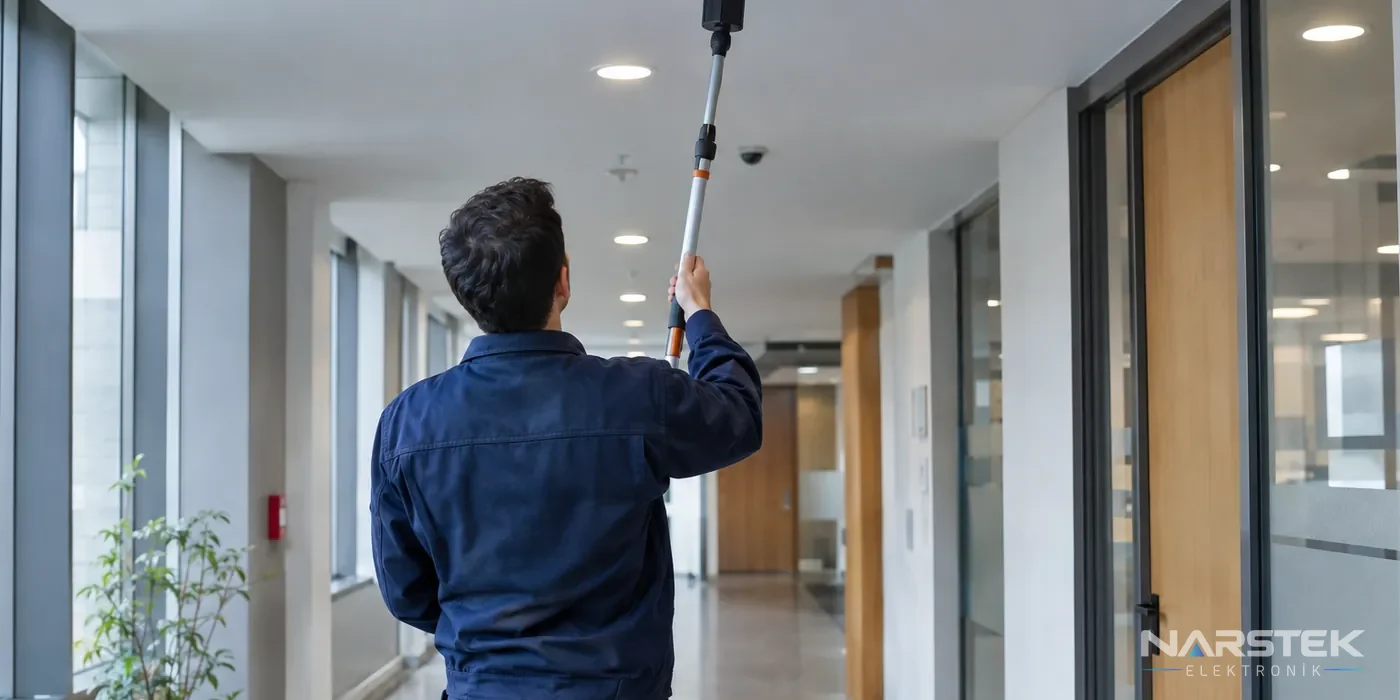
| 4 | Detector tests | Tests smoke, heat and multi-sensor detectors using an appropriate method. For beam detectors, checks the transmitter–receiver path and the panel’s alarm response. | Points tested and response result |
| 5 | Manual call points, sounders and beacons | Checks that manual call points trigger an alarm and that audible and visual warning devices operate. Plans the test in advance to minimise its impact on building use. | Test result and devices not operating |
| 6 | Modules and control outputs | Verifies the signals from input/output modules and the control scenarios specified in the design. Tests the response of connected systems in coordination with the authorised personnel responsible for them. | Module, output and scenario test results |
| 7 | Cabling and earth leakage | Checks loop or zone lines, connections, open- and short-circuit warnings, and the earth leakage indicator. Carries out any necessary measurements and inspections in a manner appropriate to the system. | Line faults and points requiring attention |
| 8 | Logbook and report | Enters test results, faults rectified and outstanding work in the maintenance record; provides the report to the responsible person. | Date, scope, results and recommended actions |
Batteries are generally 12 V VRLA lead-acid types and are replaced approximately every 3-5 years in accordance with the manufacturer’s recommendations. This period alone is not a sufficient basis for a decision; battery capacity must be assessed against the system’s standby and alarm duration requirements. Power supply specifications are covered by TS EN 54-4. For details on battery selection and replacement, see our article When should a fire alarm panel battery be replaced?.
What to check when testing detectors and warning devices
The test method must be appropriate to the device type. The response checks for smoke detectors, heat detectors and multi-sensor devices are not identical. Testing beam detectors must also follow the device’s transmitter–receiver arrangement and the manufacturer’s instructions. After testing, check that the correct device or zone is shown on the panel and that the alarm is transmitted as expected.
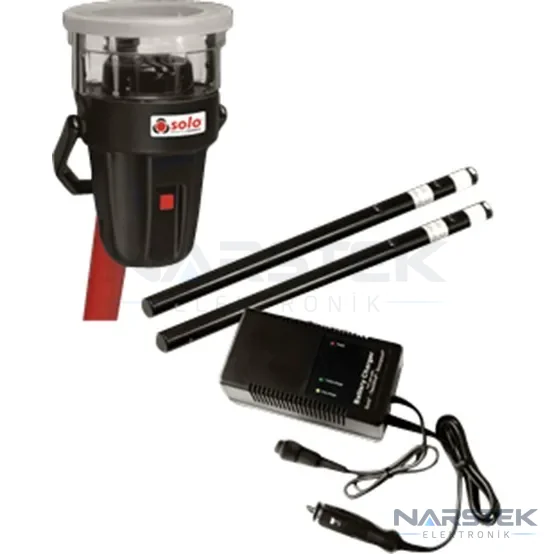
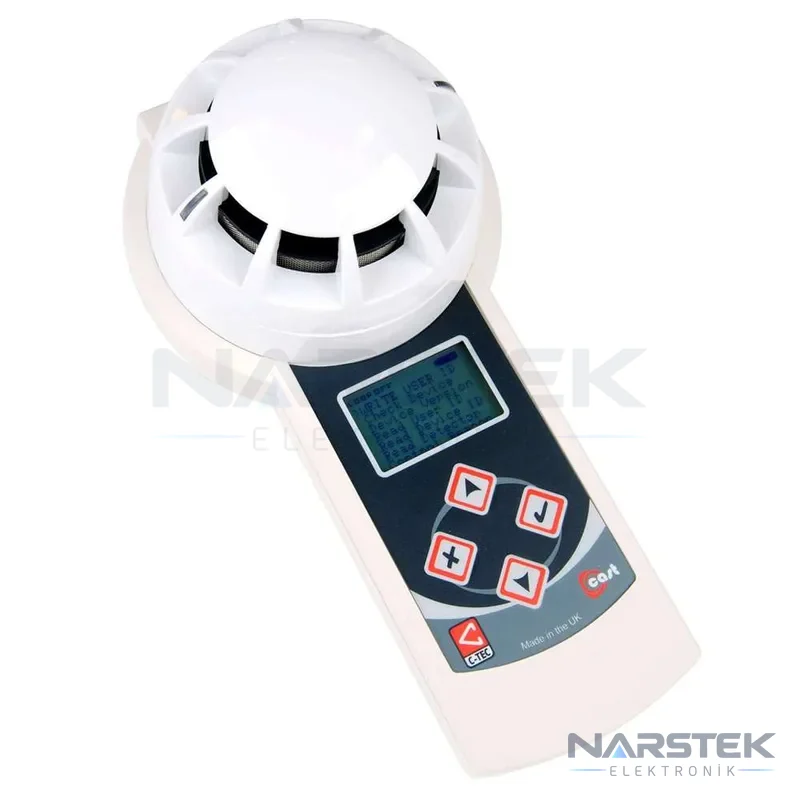
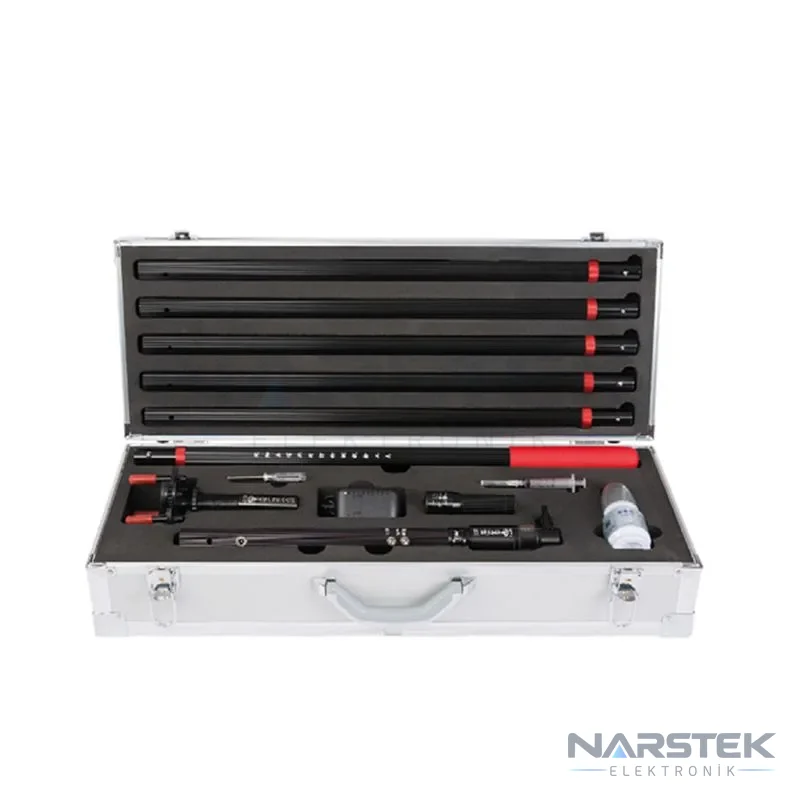
Examples of test equipment used on site include FF SMOKE-PRO for functional testing of heat and smoke detectors and 29600-212 for testing wireless heat detectors. CAPROG can be used to address and test devices on C-TEC CAST addressable systems. Equipment suitability depends on device and system compatibility; the technician should select the equipment.
When testing sounders and beacons, it is not enough to confirm that the device operates; the panel response and connected scenarios must also be checked. Public address control equipment is covered by EN 54-16, audible warning devices by EN 54-3, and visual warning devices by EN 54-23. Smoke detectors are associated with EN 54-7, heat detectors with EN 54-5, manual call points with EN 54-11, and beam detectors with EN 54-12.
Why cabling, records and reporting are part of the inspection
A loop is a ring circuit fed from both ends. Isolators help protect the remaining section of the circuit in the event of a short circuit. During maintenance, checking for line faults, connection issues and earth leakage warnings helps identify the source of an indication shown on the panel. Fire alarm circuits use fire-resistant, halogen-free cable, for example cable rated FE180 or PH120. The suitability of the existing installation is assessed in conjunction with the project and system specifications.
The way faults appear on the panel differs between addressable and conventional systems. You can learn about how systems that identify each device individually work in our article on the difference between addressable and conventional fire alarm systems. At the end of maintenance, the report should clearly list the points tested, devices not working, faults rectified, sections taken out of service and actions to be followed up. Verbal information is no substitute for a maintenance record.
To request a maintenance quote from Narstek
Narstek Elektronik, based in Istanbul, provides site surveys, design, installation, maintenance and fault repair services for fire detection and alarm systems. Projects and products are also supplied across Türkiye. Find out more about our security systems servicing and maintenance service or complete the site survey and quote request form.
For an initial assessment, please share the building’s full address, the system make and model, whether it is addressable or conventional, the approximate number of devices or zones, and any fault message shown on the panel. The date of the last maintenance visit, the existing installation drawings, the latest report and details of any building alterations will also help clarify the scope. You can submit a service request, call 0212 424 07 24, or message us on WhatsApp at 0540 001 07 24.
Frequently asked questions
How often should a fire alarm system be maintained?
Maintenance frequency in buildings is determined by the system requirements and relevant standards; Article 84 of the Regulation does not specify a fixed interval in days or months. For workplaces, periodic inspections are carried out once a year in accordance with the specified regulations, based on the installation project and TS CEN/TS 54-14.
Can a building manager test the detectors themselves?
The manager can monitor panel warnings, the visible condition of devices and whether access is unobstructed. Rather than applying smoke or heat to detectors or adjusting panel settings, testing should be left to an authorised technical team using appropriate equipment and methods.
What information should a maintenance report include?
The report should include the visit date, devices and areas tested, events shown on the panel, test results and faults rectified. Outstanding faults, disabled points and recommended work should also be clearly documented.
Is an installation project required for the periodic inspection of a fire alarm system?
Under the amendment dated 23 December 2025, an installation project is required for the periodic inspection of fire detection and alarm system installations. The employer must ensure that installations without a project are designed in accordance with the regulations and relevant standards.
Share the panel brand, number of devices and address, and we’ll get back to you about a site survey and quote.