
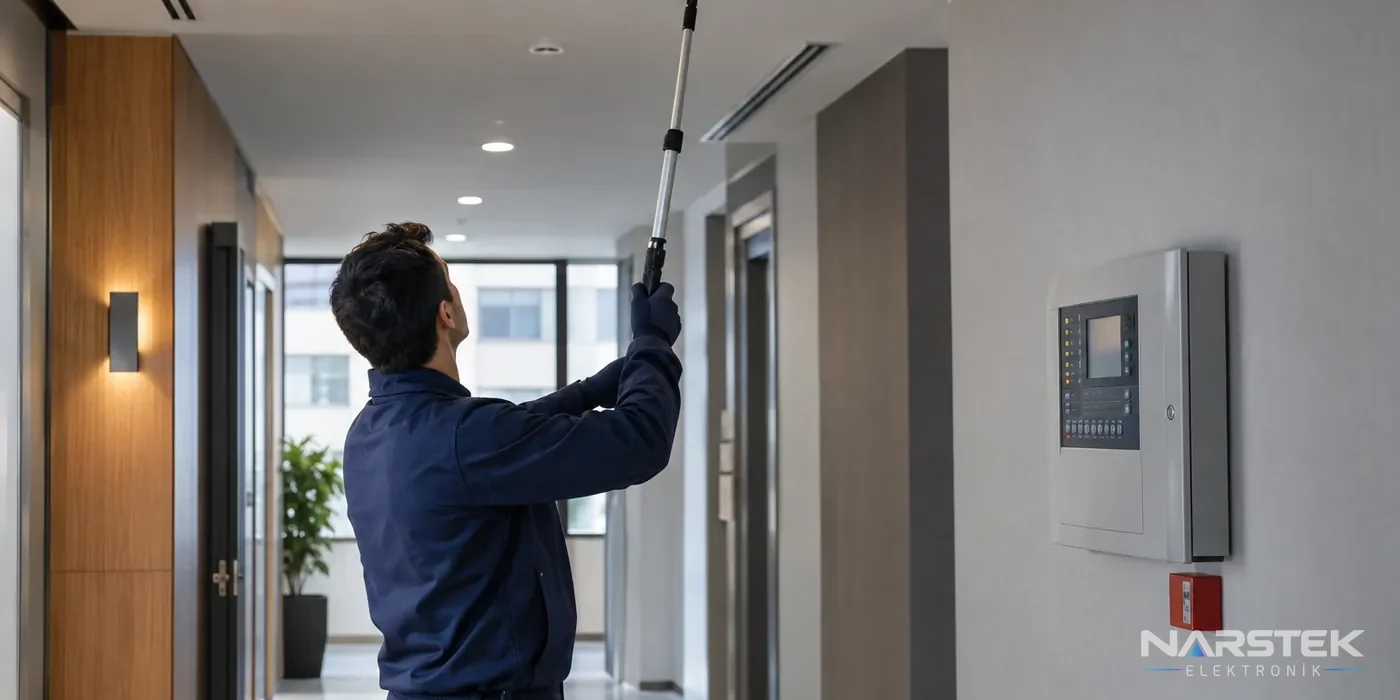
A fire alarm maintenance contract should clearly define which systems will be checked, at what intervals, and what each party must do in the event of a fault. Simply stating “maintenance services will be provided” in the contract is not enough for building management to assess the service and follow up on outstanding work.
Check the 10 clauses below in the draft contract. Exclude any clauses that do not suit your building or system; in particular, put the response time, spare parts and report delivery in writing.
Define the Contract Scope from the Outset
First, specify the service address and attach the system inventory. A fire detection and alarm system should not be understood to mean only the main panel; detectors, manual call points, sounders and beacons, circuits, modules, power supplies and batteries should also be clearly listed as within scope. If the building also has emergency lighting and signage systems, state separately whether these are included in the contract.
If it is stated that another system connected to the fire alarm system will be checked, clarify which interfaces will be tested. For example, is checking the signal sent to another system when an alarm occurs included in the service, or is it a separate job? Device quantities, floor or area details and the existing design make it easier to prepare the scope schedule. Narstek provides maintenance and fault repair for fire detection systems under its Security Systems Servicing and Maintenance service.
10 Clauses to Include in a Fire Alarm Maintenance Contract
- System and device list. The panel’s make and model, loop or zone details, device types and quantities, and the building areas covered should be included in an attached list. It can be difficult to resolve later whether devices missing from the inventory are covered by maintenance. Also agree how the inventory will be updated if the building is modified or new devices are added.
- Maintenance and inspection frequency. Regulations require periodic testing, maintenance and inspection as specified by the relevant standards and as required by the system; they do not set a single maintenance frequency in days or months. Fire detection and alarm systems in workplaces are also subject to a periodic inspection once a year. Do not assume that the visits scheduled under a maintenance contract are the same service as the periodic inspection required by regulations; ask clearly which service is being provided under the contract.
- Tests to be carried out at each visit. List tasks such as checking the panel’s normal operating and fault conditions, testing selected detectors and manual call points, checking audible and visual alerts, and inspecting the batteries and power supply. If every device is expected to be tested individually at each visit, state this clearly. The procedure should also explain how areas that need to be disabled during testing will be managed and how their return to service will be verified.
- Fault response time. Specify which phone number or email address should be used to report a fault and when the response time begins. Instead of unmeasurable wording such as “as soon as possible”, define separate response times for working hours and out of hours. If the initial remote assessment and sending a technician to site are separate steps, ask for the commitment and conditions for each.
- Out-of-hours call-out arrangements. Specify who should be contacted in the evenings, at weekends or on public holidays, how calls will be logged and whether this service is included in the contract price. Distinguish between the response time for an out-of-hours call and the time taken to reach the site. Also set out how the contact list will be updated when the building’s responsible person changes.
- Spare parts and pricing. Specify which consumables are included in the contract price and how additional work, such as battery or device replacement, will be charged. Decide whether written approval is required before parts are replaced and what information the quote must include. If faulty parts need to be shown to or handed over to the customer, set out that process too. Separating maintenance fees from parts and repair charges makes it easier to monitor the budget.
- Reporting and maintenance log. At the end of each visit, request a service report listing the areas tested, faults found, devices taken out of service and work carried out. For outstanding work and recommended part replacements, the report should state the person responsible and the target date. Specify in the contract how soon the building manager will receive the report, who will enter it in the maintenance log and how previous reports will be retained.
- Responsibilities. Explain which tasks are the maintenance company’s responsibility and which duties fall to building management, such as providing access and an escort, reporting system changes and coordinating during tests. Agree how the service company should be notified of alterations, dust, painting or changes in how an area is used that could affect the system. Any issue identified during a maintenance visit that falls outside the contract scope should be listed separately in the report.
- Insurance and health and safety arrangements. Ask what insurance and health and safety measures the service provider has in place to address risks to its staff and third parties during work. The parties should clearly agree on site access, permits to work, escorts and precautions to be taken if the system is temporarily taken out of service. These provisions help with site planning, particularly in businesses where production or services must continue.
- Contract term, renewal and termination. Specify the start and end dates, renewal terms, price adjustment method and notice period for termination by either party. Also agree how the inventory, reports and outstanding faults will be handed over to a new service provider when the contract ends. Clearly define the notification and corrective action steps to follow if the service is interrupted or obligations are not met.
Distinguish maintenance from periodic inspection
Article 84 of the Regulation on the Protection of Buildings from Fire makes the building owner and manager responsible for ensuring that emergency lighting, exit signage, and fire detection and alarm systems receive the periodic inspections, tests and maintenance required by the relevant standards. If responsibility has been formally delegated in writing, the authorised building representative is also included. The Regulation does not set a single maintenance interval in days or months; the system and relevant standards should be taken into account.
For fire detection and alarm systems in workplaces, the Regulation on Health and Safety Conditions in the Use of Work Equipment also requires an annual periodic inspection. This inspection must be carried out in accordance with the system design and TS CEN/TS 54-14. Under the amendment published in Official Gazette No. 33116 dated 23 December 2025, the installation design must be available during the periodic inspection; if no design exists, the employer must have the installation properly designed.
The periodic inspection assesses whether the installation complies with its design, the Regulation and the relevant standards. The person carrying out the inspection must have the qualifications specified by law; eligible professionals include those with relevant engineering and technical qualifications, as well as authorised electronics engineers. When signing a maintenance contract, confirm separately whether the annual inspection is included in the service and who will prepare the inspection report. Further details for workplaces are available in our article on periodic fire detection inspections and design requirements for workplaces.
How to Track Visit Schedules and Reports
At least two comprehensive maintenance visits a year, together with regular brief user checks, are common practice in the industry; this is not an interval set by regulation as mandatory for every building. When deciding the frequency for your building, take into account the system design, how the building is used, the manufacturer’s documentation and the relevant standard. The plan should also specify who will carry out user checks and to whom the findings should be reported.
Do not simply file maintenance reports away. After each visit, add outstanding faults, recommended work, the person responsible and the completion date to a tracking list. For examples of how detectors are tested, see our fire alarm system maintenance checklist. You can also review the factors that determine fire alarm maintenance costs when assessing how maintenance fees are calculated.
To request a maintenance quote from Narstek
Narstek Elektronik, based in Istanbul, provides site surveys, design, installation, maintenance and fault repair for fire detection and alarm systems. It also supplies products and delivers projects across Türkiye. To receive a quote tailored to your building’s current setup, provide the system address, panel make and model, approximate number of devices or zones, number of floors and building use. If available, also include the installation design, latest maintenance report, list of outstanding faults and requested visit frequency.
For a site survey and quote, use the survey / quote form. You can submit a technical service request using the service form. Call us on 0212 424 07 24 or contact us on WhatsApp at 0540 001 07 24.
Frequently asked questions
How many visits per year should a fire alarm maintenance contract include?
Regulations do not specify a single maintenance visit frequency in days or months; the frequency is determined by the system’s requirements and the relevant standards. At least two comprehensive maintenance visits per year, along with regular brief checks by the user, are common in the industry. However, this should not be presented as a mandatory regulatory interval.
Does a maintenance contract meet the annual periodic inspection requirement?
Not always. Fire detection and alarm systems in workplaces must undergo a periodic inspection once a year; confirm separately whether this inspection and its report are included in the contract.
Is an installation project required for the periodic inspection of a fire alarm system?
Yes. Under the amendment dated 23 December 2025, an installation design is required for the periodic inspection of fire detection and alarm systems. The employer must arrange for an installation without a design to be designed appropriately.
What information should I include in a maintenance quote request?
Share the system address, the panel’s make and model, the number of devices or zones, the building’s use and the number of floors. If available, include the installation design, the last maintenance report and a list of outstanding faults to help ensure the quote is scoped correctly.
Share the panel brand, number of devices and address, and we’ll get back to you about a site survey and quote.