
When selecting a Global Fire fire alarm control panel, first establish the building's detection requirements, the number of devices and the panel's expansion plans. Series names such as JUNO-NET, OCTO and GEKKO do not, on their own, provide information about capacity or compatibility; check each model's specifications and supported peripheral devices against the manufacturer's documentation.
The Global Fire product range includes fire alarm control panels, detectors, manual call points, sounders and beacons, input/output modules, and Carbon Monoxide (CO) detection products. For ZEOS detectors, explosion-proof products and specialist detection solutions, assess the site conditions alongside the model's technical documentation.
What Information Should You Consider When Selecting a Panel Series
Selecting a panel based solely on the building's floor area will not give you the right result. Consider together the number of detection points in the project, where manual call points are required, which devices need to operate during an alarm scenario, and whether additional areas may be added in the future. The panel's loop count and supported device capacity should also be confirmed against the model documentation.
Values such as capacity, network configuration and supported device count are not provided here for the JUNO-NET, OCTO and GEKKO series. Therefore, rather than relying on the series name alone, specify the full model code and the panel's software or hardware version in the quote. If multiple panels are to communicate over a network, also check the compatibility of the communication card to be used.
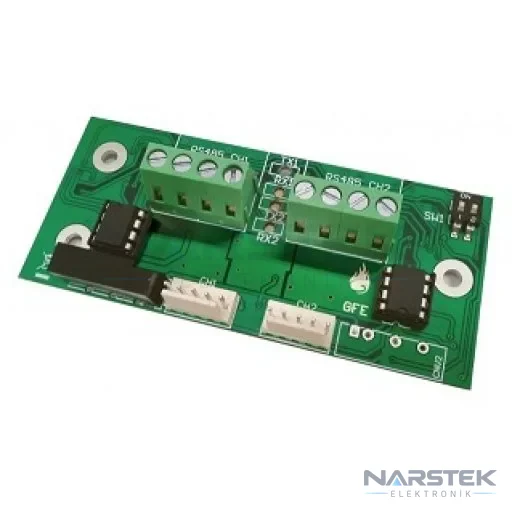
For example, CHAMELEON-485-DTLOOP is an interface card that enables addressable fire alarm control panels to communicate with GFE repeater panels and compatible panel units. The product information also lists the JUNIOR and JUNO NET series. This does not mean that every panel combination is automatically compatible; confirm the correct card and connection arrangement for the project against the manufacturer's documentation.
Differences Between Addressable Systems, Conventional Systems and Loops
In an addressable system, each detector, manual call point or module appears on the panel under its own address. This makes it easier to identify which device has triggered an alarm. In a conventional system, the panel monitors devices by the zone they are connected to, rather than individually. The two systems differ in how faults are identified and the system is expanded.
| Feature | Addressable system | Conventional system |
|---|---|---|
| Location information on the panel | Devices are displayed under separate addresses | Alarms or faults are monitored by zone |
| Wiring configuration | A loop is a ring circuit powered from both ends | Devices operate on a zone circuit |
| Compatibility Checks | Detectors and modules must be compatible with the panel protocol. | The zones and device features supported by the panel are checked. |
Addressable detectors and modules are tied to the panel protocol; products from different brands are often not directly compatible. When replacing a panel, verify protocol and product compatibility before connecting existing detectors to the new panel. For a more detailed comparison of the differences between addressable and conventional systems, see our comparison of addressable and conventional fire alarm systems.
Loop isolators help keep the remaining part of the loop operational if a short circuit occurs. Cable selection is also part of the system design. Fire alarm circuits use fire-resistant, halogen-free cables; classes such as FE180 or PH120 are assessed according to the project requirements. These ratings should be checked against the project design and product documentation.
Examples of Global Fire Products from the Catalogue
The examples below show that a panel is more than just the main control unit. Components should be selected according to the system protocol, application and required scenario.
- G-ONE1 is a single-loop addressable control panel that can operate on a network with panels compatible with the Chameleon protocol. It can be surface-mounted or flush-mounted.
- DLFB30-R is a relay-output beam detector designed for linear smoke detection at distances of 3 to 30 metres. Its product information lists approvals to EN 54-12 and EN 54-17.
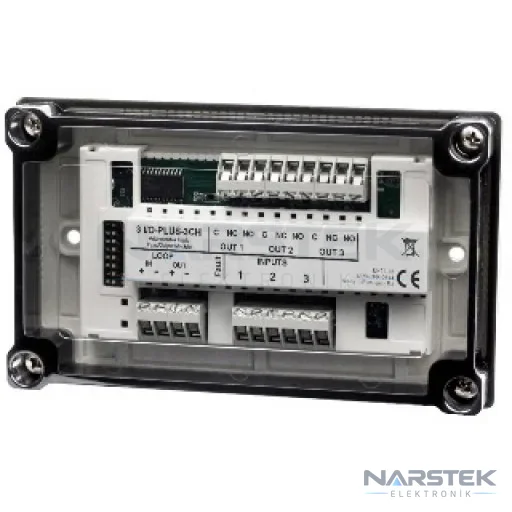
- 3 IO PLUS CH is a loop-powered input/output module offering up to three inputs and three outputs.
- VALKYRIE-AS is a wall-mounted addressable electronic sounder powered via the loop. It is available with a red or white housing.
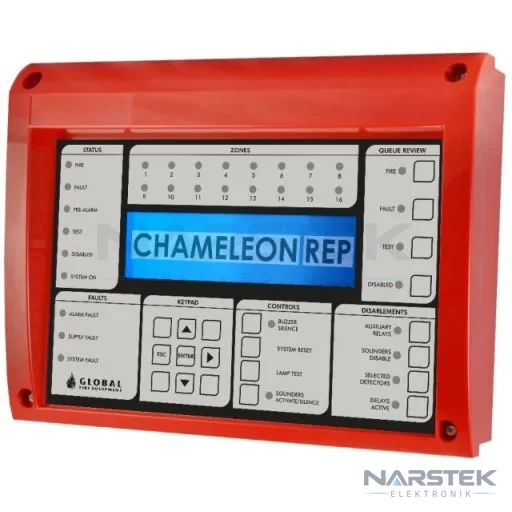
- CHAMELEON REP operates as a repeater panel in a Chameleon Network system; it can process system information and record it in the event log.
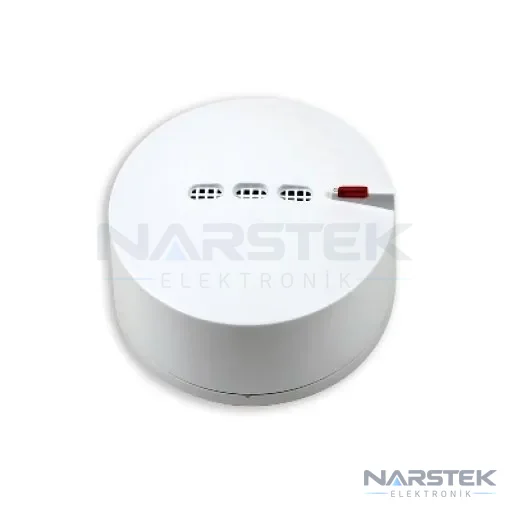
- DMD500 is a carbon monoxide detector connected to CO control panels via two wires. Its product information specifies a resolution of 1 ppm.
- CMD501 is a CO control panel that can be expanded from one zone to up to three zones; 32 detectors can be connected to each zone.
When combining these components, being from the same brand alone does not prove that they will work together. For addressable detectors, modules and sounders in particular, check the panel protocol and the connection type supported by the product. You can browse the product ranges on the Fire Panels and Global Fire Products pages.
ZEOS, Ex-Proof and Special Detection Products
When assessing a ZEOS detector, ex-proof equipment or a special detection product, first identify the characteristics of the area to be protected. Conditions such as dust, humidity, air movement, high ceilings, process-generated smoke or an explosive atmosphere can affect the choice of detector type. For these product groups, verify the model’s operating limits and compatibility with the panel using the manufacturer’s current technical documentation.
In large areas with high ceilings, beam detection may be considered as an alternative to point detectors. The DLFB-R is designed for large spaces and long corridors where point detectors are unsuitable. Mounting distance, line of sight and the product’s operating conditions should be assessed against the project requirements when selecting a detector. For information on smoke detection methods and layout planning, visit our Fire Detection and Alarm Systems service page.
CO detection and system operation
Carbon monoxide detection addresses a gas detection requirement separate from fire alarm systems. Detectors such as the DMD500 are connected to a CO control panel, while the CMD501 monitors detectors across zones. In areas such as car parks, the number and layout of devices, and the control strategy, are determined according to the project. For product categories, visit the Carbon Monoxide (CO) Detectors page.
During commissioning, device addresses and zones are checked, alarm and fault notifications are tested, and the panel event log is reviewed. The maintenance plan includes functional testing of detectors and manual call points, checking circuits and connections, and inspecting the batteries. Panel batteries are generally 12 V VRLA lead-acid batteries and are replaced approximately every 3-5 years, in line with the manufacturer’s recommendations. Capacity is calculated with the standby and alarm periods in mind; the power supply is assessed in accordance with TS EN 54-4.
When selecting audible and visual warning devices, the relevant standard class and the conditions of the premises are considered together. EN 54-3 covers audible warning devices, EN 54-23 visual warning devices, EN 54-7 smoke detectors, EN 54-5 heat detectors and EN 54-11 manual call points. For other detection types, EN 54-12 covers beam detectors and EN 54-20 aspirating smoke detectors; EN 54-25 covers wireless components, while EN 54-16 covers voice alarm control equipment.
Request a Site Survey and Quote from Narstek
Based in Istanbul, Narstek Elektronik provides site surveys, design, installation, maintenance and fault repair services for fire detection and alarm systems. We also provide servicing and product supply for carbon monoxide detection, CCTV, public address, fire suppression, access control and intrusion alarm systems. For projects outside Istanbul, you can also enquire about project services and product supply across Türkiye.
When requesting a quote for a Global Fire fire panel or peripheral products, please provide the exact model of the existing panel, any available device and loop lists, the building’s purpose, floor and area plans, and the estimated number of detectors and manual call points. If the system is to be expanded or upgraded, existing fault records, a photo of the panel and the requested scope of work will also help with the site survey.
You can complete the site survey / quote form, call us on 0212 424 07 24, or message us on WhatsApp at 0540 001 07 24. For maintenance and fault support, you can submit a technical service request.
Frequently asked questions
Can detectors from other brands be used with a Global Fire addressable panel?
Compatibility of addressable detectors and modules depends on the panel protocol; products from different brands are often not directly compatible. Before connecting them, verify compatibility against the panel model and the device manufacturer’s documentation.
How is the capacity of JUNO-NET, OCTO and GEKKO panels determined?
Check the full model code and the technical values in the manufacturer’s documentation. Capacity should not be determined from the series name alone; the number of devices and loop and network requirements must first be established for the project.
Do DMD500 and CMD501 refer to the same product?
No. DMD500 is the detector used to detect carbon monoxide. CMD501 is the control panel used for the CO detection system, which can be expanded to cover one to three zones.
When should a fire alarm panel battery be replaced?
Panel batteries are typically 12 V VRLA lead-acid batteries and should be replaced approximately every 3-5 years, in accordance with the manufacturer's recommendations. The required capacity should be calculated based on the system's standby and alarm durations.
Share the panel brand, number of devices and address, and we’ll get back to you about a site survey and quote.