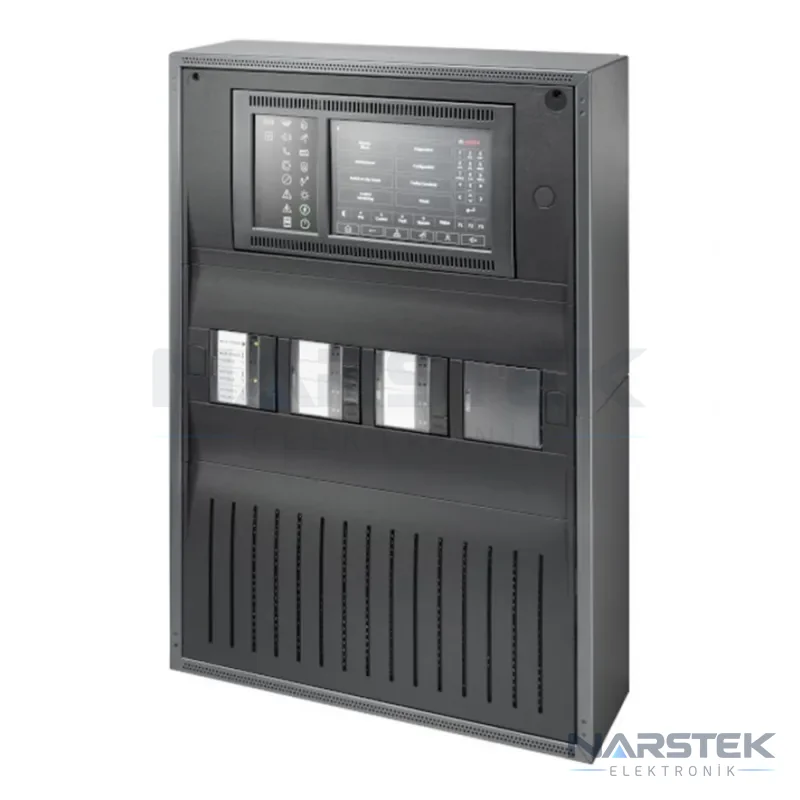
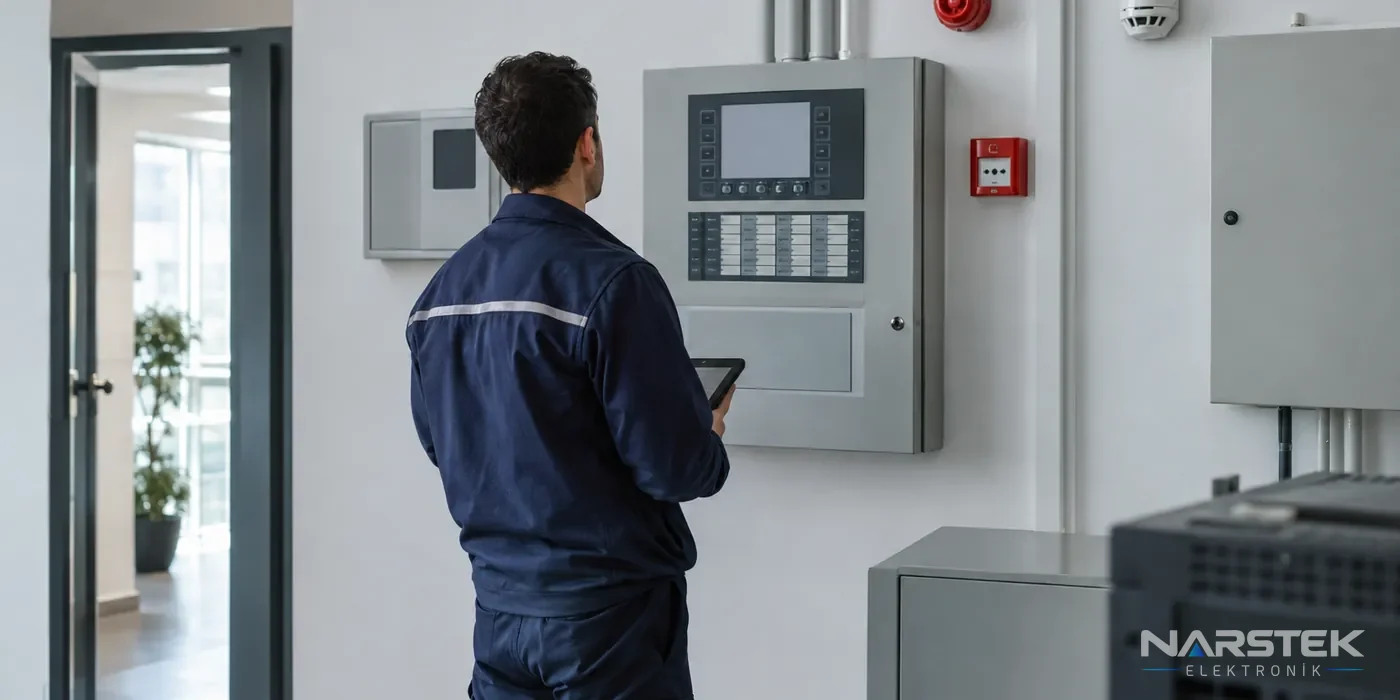
During periodic maintenance of a Bosch AVENAR 2000/8000 or FPA-5000 fire panel, the panel logs, power supply, detectors, manual call points, sounders and LSN loops are checked. The aim is to verify not only that devices appear on the panel, but also that they operate as expected in an alarm condition.
The maintenance plan should be prepared in accordance with the system design, manufacturer documentation and relevant standards. Tests carried out during Bosch fire panel maintenance are planned according to the building’s use and, where possible, coordinated with the building representative.
What Information Is Reviewed Before Maintenance
The technician first checks the panel model, its software and hardware configuration, the number of loops and the devices configured in the system. The existing installation drawings and previous maintenance reports are used to compare the devices and addresses on site. Any discrepancy between the drawings and the system shown on the panel should be recorded in the report.
Before maintenance, the scope and timing of the tests are agreed with the building manager. The relevant departments are informed, as siren or manual call point tests may affect building occupants. If any parts of the system will be taken out of service during testing, these must be recorded, and their return to normal operation must be verified once testing is complete.
In addressable systems, devices are monitored at the panel using individual addresses. Any incorrect address, missing device or device registered at the panel but not present on site is assessed alongside the event log and loop check. Compatibility of addressable detectors and modules depends on the panel protocol; a device from a different manufacturer must not be assumed to work on the existing loop.
Panel event log and fault history
Fire alarms, faults, disabled devices and user actions are reviewed in the event log. Repeated alerts from the same address, brief interruptions to the line, or frequent silencing and reset operations are also investigated. The logs alone may not reveal the cause of a fault; they should be compared with the devices and installation on site.
The absence of active faults at the panel does not mean that all system functions have been tested. For example, alarm outputs and field sounders should also be tested. The panel’s date and time settings are checked so that events can be reviewed in the correct sequence.
Any missing or disabled devices identified during maintenance are listed in the report with their address and location. The reason for any temporary disablements made by the building’s staff, and whether they have since been cleared, should also be confirmed. For help interpreting panel alerts, see our fire panel fault alerts article.
How to check the battery and power supply
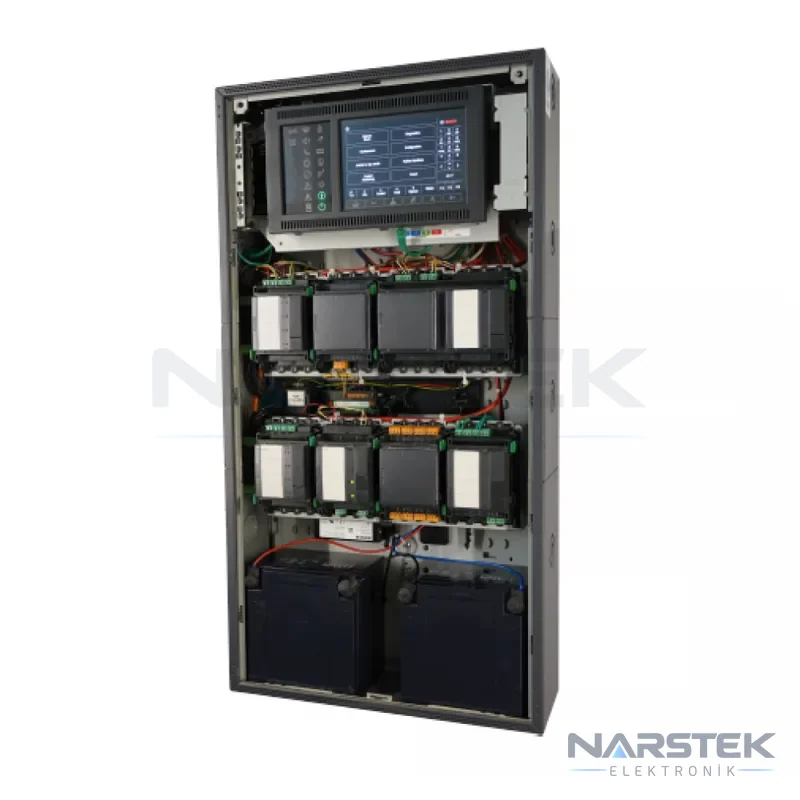
The panel’s mains supply, power supply alerts and battery connections are inspected. Batteries are checked for physical damage, swelling, leakage, loose connections and oxidation on the terminals. Battery condition and charging function are then assessed using the method specified in the manufacturer’s documentation.
Fire panels generally use 12 V lead-acid VRLA batteries. Replacement timing is determined by the battery’s condition, operating conditions and the manufacturer’s recommendations. A period of approximately 3-5 years is a general estimate, not a definitive replacement date for every battery. The required battery capacity is calculated based on standby and alarm durations; TS EN 54-4 is taken into account when assessing the power supply.
Battery test results should not be assessed solely by looking at the voltage shown on the panel. The test method and measurement conditions should be recorded in the report, and a capacity assessment and replacement recommendation should be provided for batteries found to be weak. For more information about battery selection and replacement, see our fire panel battery replacement page.
Detector, manual call point and sounder tests
Detectors are inspected for contamination, physical damage, paint or dust build-up, and the conditions in their surroundings. If the panel or manufacturer’s software displays a contamination value, it is recorded and interpreted according to the manufacturer’s assessment method. A single threshold must not be assumed to apply to all detectors; thresholds and remedial actions depend on the device documentation.
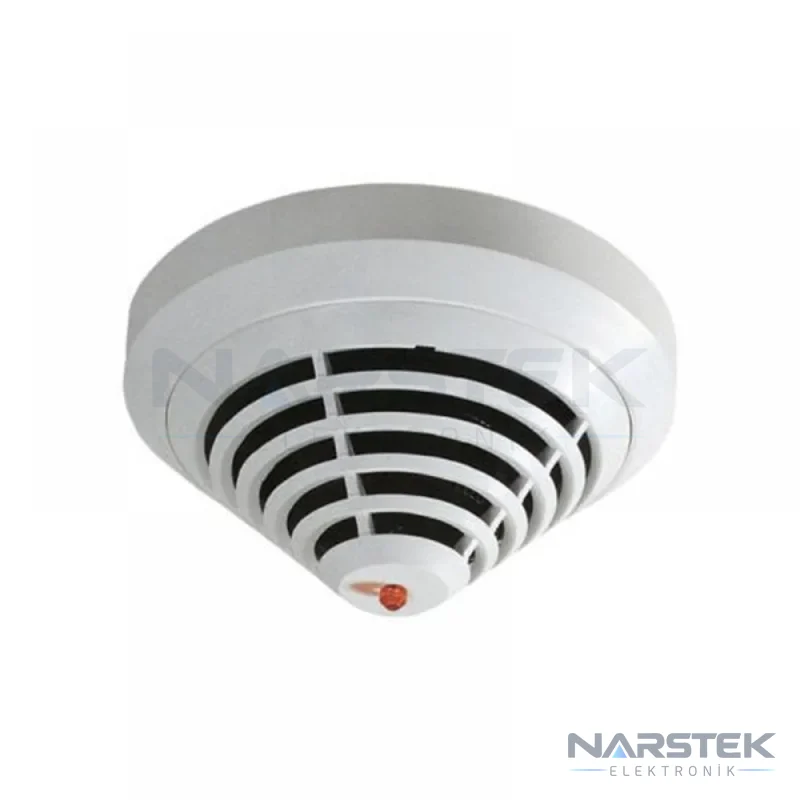
As an example, the FAP-425-O optical smoke detector is one of the catalogue examples in the Bosch product range. The FAP-425-OT, which combines smoke and heat detection, can also be considered as a product example for different applications. Before adding or replacing a device in an existing system, the panel protocol and manufacturer compatibility must be confirmed. See the detectors category for other products.
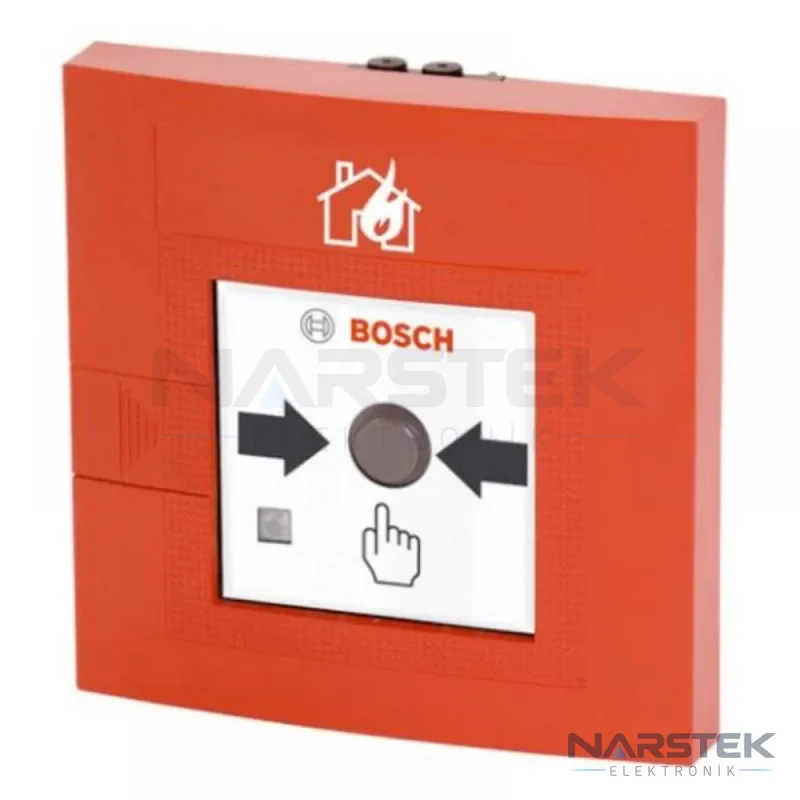
Manual call points are operated using a suitable test method, and the correct address is verified as being in alarm at the panel. FMC-210-DM is one of the manual call point examples in the catalogue. Once testing is complete, check that the call point has returned to its normal state and that the corresponding alarm has been reset at the panel.
During the sounder test, check that the field sounder operates and that the panel correctly indicates the output status. Depending on how the building is used, review the areas where audible alerts can be heard. Sounders must not be tested without the building manager’s knowledge. See the Sounders and Beacons page for sounder and beacon product ranges.
What to check during an LSN loop inspection
The devices detected by the panel on the LSN line are compared with the project and site information. Check for open circuits, short circuits, earth faults or recurring communication faults on the line. The purpose of loop isolators is to protect the remaining part of the line in the event of a short circuit; during maintenance, the line and isolator behaviour are checked in accordance with the system design.
The location and address of every device in an addressable system should be verified on site during maintenance. If alterations have been made to cable routes or connection points, confirm whether these changes have been incorporated into the project documentation. The installation inspection also includes checking that fire alarm lines use fire-resistant, halogen-free cable in accordance with the project specifications.
The panel configurations and peripherals used in AVENAR 2000, AVENAR 8000 and FPA-5000 systems may differ. For example, AVENAR panel 2000 and AVENAR 8000 may be used in systems of different scales and configurations. The checks should be adapted to the panel version, project and manufacturer documentation.
What should a maintenance report include?
A maintenance report should document the work carried out and the system’s condition at that time in a way that the building manager can follow. A note stating only “checked” is not sufficient for comparison at the next maintenance visit or for fault tracking.
- Panel and installation details, maintenance date and inspection team.
- Review of the event log, existing faults and disabled devices.
- Battery and power supply test method and findings, with any replacement recommendations.
- Detector contamination values or status shown in the manufacturer’s interface.
- Results of manual call point, sounder and LSN loop tests.
- Missing, damaged or project-mismatched devices, with their addresses and locations.
- Outstanding work, the responsible party and recommended follow-up.
The report may include an equipment list and measurement records, where necessary. Any faults that could not be resolved during maintenance must be clearly stated, and the building representative must be informed which part of the system may be affected. Maintenance, fault diagnosis and repair requests may be considered as part of Narstek’s fire safety systems servicing and maintenance service.
Periodic Maintenance and Legislation
Under Article 84 of the Regulation on the Protection of Buildings from Fire, fire detection and alarm systems must undergo the periodic inspection, testing and maintenance required by the system and specified in the relevant standards. This is the responsibility of the building owner and manager, or the building representative appointed in writing. This article alone does not set a fixed maintenance interval in days or months for all buildings; the frequency is determined by the system and the relevant standards.
At least two comprehensive maintenance visits per year, along with regular brief checks by the user, are common industry practice; this should not be treated as a fixed number required by the Regulation. For fire detection and alarm systems in workplaces, the Regulation on Health and Safety Requirements for the Use of Work Equipment requires an annual periodic inspection, in accordance with the project and TS CEN/TS 54-14, following the amendment of 18 February 2022.
Under the amendment published in the Official Gazette dated 23 December 2025, No. 33116, an installation project is required for the periodic inspection of these systems. The employer must arrange for installations without a project to be designed in accordance with the relevant Regulation and standards. The inspection assesses whether the installation complies with its project, legislation and standards. You can also read our article on periodic inspections of fire detection systems in workplaces for information about authorised professional groups and project requirements.
To request a maintenance quote from Narstek
Based in Istanbul, Narstek Elektronik provides site surveys, design, installation, maintenance, fault repair and maintenance services for fire detection and alarm systems; it also supplies products and undertakes projects across Türkiye. When requesting a quote for your AVENAR or FPA series system, please share the panel model, building type and address, approximate number of devices and loops, any existing fault list, and whether an installation project is available. Previous maintenance reports or panel event logs can also help define the scope of work accurately.
For a technical service request, you can use the service form; for a site survey and quote, please complete the quote form. You can reach us by phone on 0212 424 07 24 or via WhatsApp on 0540 001 07 24.
Frequently asked questions
How often should a Bosch fire panel be maintained?
Article 84 of the Regulation does not set a fixed month or day interval for every building; the interval is determined by the system requirements and relevant standards. In workplaces, there is a requirement for an annual periodic inspection. Set the maintenance schedule separately from this inspection requirement, in accordance with the system and manufacturer documentation.
If a detector’s contamination level is high, should it be replaced immediately?
A decision should not be based on a single general threshold. The reading should be interpreted using the method specified in the documentation for the relevant detector; cleaning, reassessment or replacement should be recommended and recorded as appropriate.
Can detectors from a different brand be connected to an FPA-5000 or AVENAR panel?
Compatibility of addressable detectors and modules depends on the protocol used by the panel. Do not assume that a product from a different brand will work; compatibility between the panel and device should be verified using the manufacturer documentation.
Is a maintenance report the same as a periodic inspection report?
A maintenance report records the service work carried out and the findings. The project and conformity assessment for periodic inspections carried out under workplace regulations constitute a separate inspection requirement; the relevant reporting and authorisation requirements should be considered separately.
Share the panel brand, number of devices and address, and we’ll get back to you about a site survey and quote.