
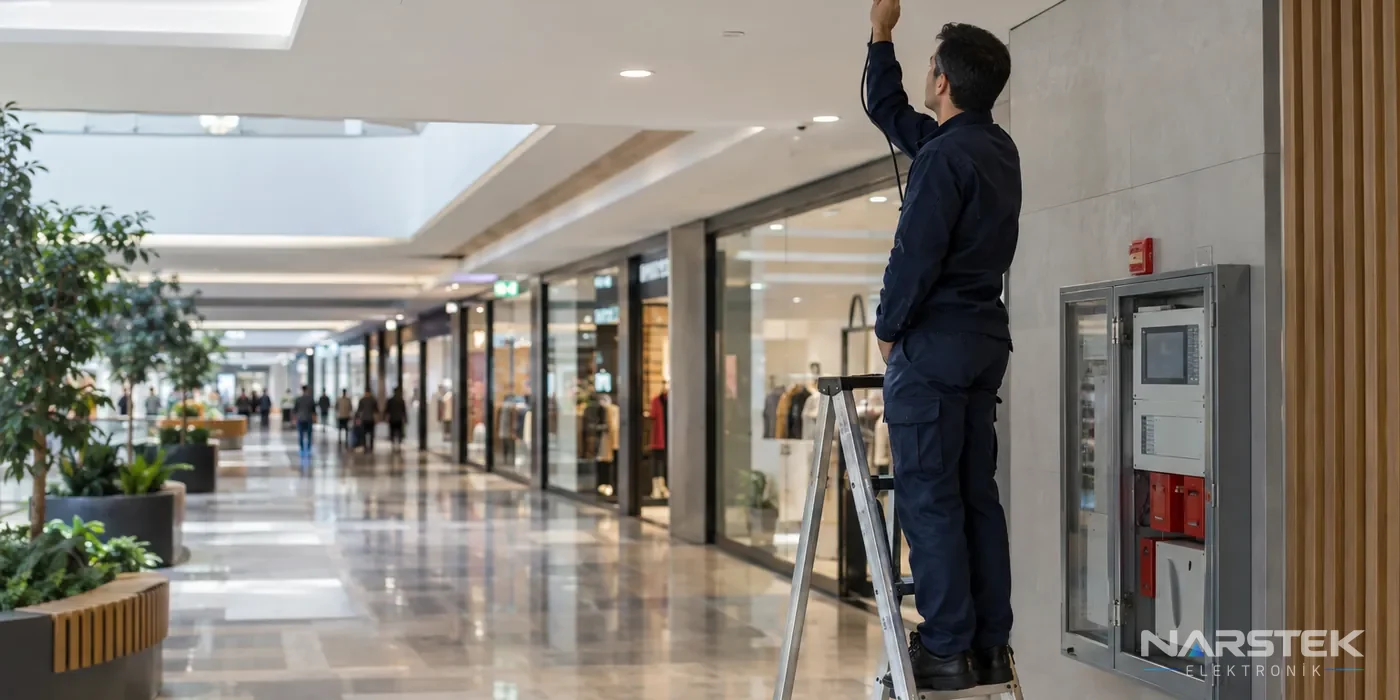
A public address system is used to give clear instructions to people inside a building during a fire. A siren usually provides an audible warning, while a public address system can deliver an evacuation message to selected zones. Whether one is required in a particular building depends on its use, the fire strategy and the approved design.
EN 54-16 is a standard relating to control equipment for voice alarm systems. Correct operation depends on more than selecting this equipment. Integration with the fire panel, speaker placement, message intelligibility and regular maintenance should all be considered together.
The Difference Between a Siren and Voice Evacuation
A siren alerts building occupants to an alarm but generally does not explain what they should do. A voice evacuation message can provide instructions such as the direction of evacuation, areas to avoid or the evacuation of a particular zone. Messages may be pre-recorded or delivered live by authorised personnel using a microphone.
A voice message does not mean that evacuation will automatically be faster in every situation. It needs to be brief, clear and audible to people in the building. Background noise, reverberation, faulty speakers and announcements sent to the wrong zone can make the instructions difficult to understand.
A voice alarm system does not directly replace sirens in every project. The fire alarm and evacuation strategy should be considered together; where required, a voice message system can be planned alongside audible warning devices. The existing fire design and relevant requirements should be reviewed to determine what is appropriate for the building.
EN 54-16 and System Components
EN 54-16 covers control equipment for voice alarm systems. This equipment manages announcement sources, message selection and distribution to zones. A system may also include amplifiers, microphones, speaker circuits and the necessary monitoring components. The suitability of the equipment for the project should be verified against the manufacturer’s documentation and the system design.
Speakers are not selected simply by placing them along corridors. Room size, ceiling height, intended use, ambient noise and sound reflection are all taken into account. Message intelligibility is as important as speaker coverage. For this reason, placement and level settings should be assessed against the design and site conditions.
A public address system can be designed to operate in coordination with the building’s fire detection and alarm system. Information from the fire panel can activate the relevant announcement zones according to the defined scenario. The method of integration depends on the interfaces of the panel and public address equipment, project requirements and manufacturer instructions.
If a public address system is to be added to an existing fire panel, simply making a connection should not be considered sufficient. The correct transfer of alarm information, monitoring of fault conditions and testing of the scenario are all necessary. For details about maintenance of fire detection equipment and panels, see our fire alarm system and panel maintenance article.
How Is Zonal Announcement Planned?
Zonal announcement allows designated areas to be managed separately, rather than sending the same message throughout the entire building. For example, floors, fire compartments or areas with different uses can be set up as separate announcement groups. The group boundaries should align with the building’s evacuation strategy.
During planning, the following points are clarified:
- Which alarm information will be transferred from the fire panel to the public address system
- Which announcement zone will be activated by each alarm
- Whether to use an automatic message or a live announcement
- How general announcements inside the building will be managed during a fire announcement
- How the system will be monitored in the event of a power or equipment failure
These decisions should be made jointly by the project team and the building managers. Using the same zone names on the panel, public address control equipment and technical documentation helps reduce confusion during operation. If partitions or building use change during later refurbishment, the public address zones should also be reviewed.
Shopping centres, hospitals, hotels and schools
In shopping centres, common areas, retail units, car parks and plant rooms have different operating requirements. Scenarios should be defined from the outset to prevent general announcements from being confused with fire announcements and to ensure messages are directed to the correct zone. Changes of tenant or shop refits may affect loudspeaker coverage.
Patient rooms, outpatient clinics and common areas in hospitals may require different evacuation approaches. Scenarios should take account of areas where people have limited mobility and any need for phased evacuation. For more information on fire detection design in hospitals, see our article on fire detection in hospitals and healthcare facilities.
Hotels need a clear, audible message plan for guest rooms, lobbies, restaurants and service areas. The message language and the areas in which announcements begin should be determined according to the building’s operating arrangements. Our article on fire alarms in hotels and accommodation facilities may also be helpful.
Classrooms, corridors, dining halls and common areas in schools each have different uses. The announcement scenario should be planned so that students and staff can hear it; loudspeaker operation should be checked after holiday periods or refurbishment. Read our article on fire alarm systems in schools and student accommodation for information about system planning.
Loudspeaker Placement and Intelligibility
Loudspeaker placement is not simply a matter of counting the units. Closed doors, partition walls, high ceilings and noisy areas can all affect how sound is heard. Placement is planned to avoid sound being too loud in one part of a corridor or room and too quiet in another, then checked on site during commissioning.
Intelligibility is about more than simply hearing the message. Speech must not be lost in reverberation, background noise must not mask the message, and the wording must be clear. During testing, the message should be listened to in every zone; if necessary, the loudspeaker position, level or zoning plan should be reviewed.
The selection of fire-resistant circuits and cables is also part of system design. Halogen-free cables in FE180 or PH120 classes may be used for fire alarm circuits; cable selection should follow the project requirements and manufacturer documentation. The cable type and route for the public address circuit should likewise be specified in the project.
What Checks Should Be Carried Out During Maintenance?
Maintenance checks include the normal operation of the control equipment, fault indicators, microphones, amplifiers and loudspeaker circuits. Confirm that automatic messages are routed to the correct zones and that live announcements are audible. Where the system is integrated with the fire panel, also verify that the alarm signal starts the announcement specified in the scenario.
Maintenance records should state which zones were tested, any faults found and the work carried out. A loudspeaker that has been obstructed, an area that has been subdivided or a change of use within the building may affect sound distribution. During maintenance, check not only that the equipment works, but also that messages are intelligible on site.
Assessing fire detection and alarm systems together with site surveys, installation, maintenance and fault repair can help identify integration issues earlier. Find out about Narstek's public address system services, or request an assessment of your existing system together with its fire panel.
Request a Site Survey and Quote from Narstek
Narstek Elektronik provides site surveys, design, installation, maintenance and fault repair for fire detection and alarm, public address, CCTV, access control and other building security systems, based in Istanbul. Projects outside Istanbul can also be supported with project services and product supply across Türkiye.
When requesting a site survey or quote, please provide the building’s use, address, number of floors and approximate area, the make and model of the existing fire panel, the status of any public address system, and any drawings or survey notes you have. Details of whether this is a refurbishment or a new installation, which areas require announcements and any existing faults will also help us make an initial assessment. You can use the site survey and quote form, call 0212 424 07 24 or message us on WhatsApp at 0540 001 07 24. If your existing system has a fault, you can also submit a technical service request.
Frequently asked questions
Can a public address system be used instead of a siren?
It should not be assumed that it can directly replace a siren in every project. A siren signals an alarm, while a voice announcement can provide evacuation or direction instructions. Its use is determined by the fire strategy and the project.
What does EN 54-16 cover?
EN 54-16 concerns the control equipment for voice alarm systems. Speaker placement, coverage within the building and integration with the fire panel must be designed and tested separately.
Can a public address system be connected to a fire panel?
Yes, if the project requirements and equipment interfaces are compatible, alarm information from the panel can activate designated announcement zones. The integration scenario, fault monitoring and on-site tests should all be verified.
What is checked during public address system maintenance?
The control equipment, microphones, amplifiers, speaker circuits and fault indicators are inspected. It should also be tested that automatic messages reach the correct zones and are intelligible on site.
Share the panel brand, number of devices and address, and we’ll get back to you about a site survey and quote.